
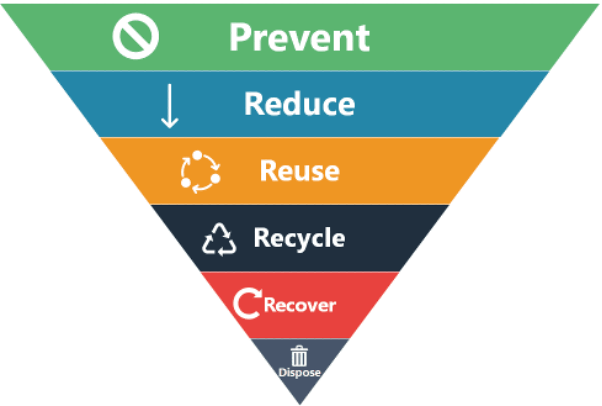
Sustainable waste management relies on a clear and well-established principle: the waste hierarchy. This model guides organisations, municipalities, and industries on how to handle waste in a way that reduces environmental impact and maximises material value. When applied to organic waste specifically, the waste hierarchy helps clarify where technologies like BiobiN fit in and why they matter in markets needing to divert organic waste from landfill.
The waste hierarchy is a globally recognised framework used to rank waste management approaches from most preferred (top) to least preferred (bottom). It is often illustrated as an inverted pyramid, with actions that avoid waste placed at the top and disposal options (often landfill) placed at the bottom. Let’s unpack this a bit more:
Prevention (reduce)
This is the most desirable level. Prevention focuses on avoiding waste altogether, for example, by purchasing only what is needed, improving inventory systems to reduce food spoilage, or designing products for long life and low impact.
Reuse
This involves using items again in their original form. Pallets, containers, and glass jars can be reused repeatedly without being broken down into new materials. Many companies often have repurposing plans in their broader waste management strategies to reuse waste materials in a different part of their operations for another use. Some retail companies, especially in clothing, base their entire production chains on material that has been repurposed. Consumers, in fact, are increasingly drawn to products made from reduced/repurposed materials.
Recycling
Recycling transforms waste into new products. When most of us think about recycling, our attention is immediately placed on solid material recycling, like plastics and metals. But this is also where composting sits. In the case of organics, food scraps, landscaping offcuts, and other biological materials are converted into soil products.
Recovery
When materials cannot be recycled, some technologies convert the remaining waste into usable energy, such as anaerobic digestion or certain forms of waste-to-energy processes. This step is less preferred because it removes material from the circular loop and often leaves behind byproducts in the recovery process.
Disposal
Landfilling and incineration without energy recovery form the lowest tier. These methods represent a linear system where material value is lost completely. This is the level that most of the waste sector is aiming to shift away from.
Where composting sits generally
Under the standard hierarchy, composting is formally placed underrecycling. This classification is based on the core function of composting: transforming organic waste into a usable product. By converting biological waste into compost, nutrients and carbon are returned to the soil. This closes a natural loop, like how recycling paper or plastic returns raw materials to manufacturing cycles. Composting, therefore, supports soil regeneration, improves water retention, and contributes to healthier agricultural systems – all of which reinforce its position as a circular, value-retaining process.