
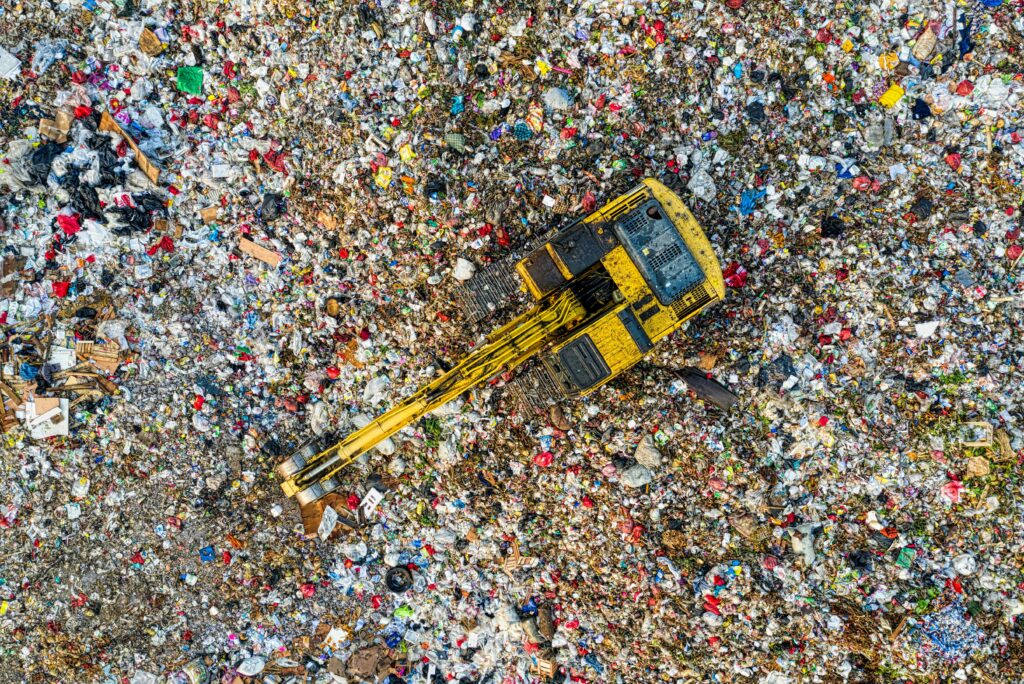
South Africa’s landfill network is nearing a point where capacity constraints and non-compliance are converging into a national issue. Many municipal landfill sites have only a few operational years remaining, and several metropolitan areas have already confirmed critically low airspace. Landfills are not as simple as they may appear on paper. They are engineered systems with structured layers, leachate control mechanisms, and methane emission capture systems. Once those systems reach capacity or begin to fail, the environmental and public-health implications become significant and costly to reverse. In light of this, every measure needs to be put in place to support the remaining lifespans of our country’s landfill sites, including the diversion of organic waste.
Recent monitoring and parliamentary reports have shown that a large proportion of municipal landfills are not meeting regulatory standards. This includes failures in waste compaction, inadequate daily cover, insufficient equipment, and weak access control. These issues reduce landfill lifespan, increase the risk of uncontrolled dumping, and undermine environmental protections designed to safeguard soil and water resources. The capacity challenge, therefore, intersects with a governance challenge, as municipalities navigate ageing infrastructure, budget limitations, and increasing waste volumes.
Landfill sites have high emission footprints
Landfills are large emitters of methane due to the decomposition of organic waste in anaerobic conditions. Methane has a far greater warming potential than carbon dioxide over a short time horizon, making landfills significant contributors to climate impacts. Recent data analyses have shown methane release rates at some sites that place them among the highest emitters in the country. Even sites considered operationally sound release substantial methane when organic waste is landfilled without proper gas capture or diversion systems.
Methane is not only a climate issue. Elevated concentrations present explosion and fire risks, and they affect air quality for nearby communities. The management of biodegrading material is therefore a public-health responsibility as much as a climate obligation.
The role of organic waste diversion
Organic waste represents one of the largest proportions of municipal waste streams. When it enters landfill systems, it occupies airspace that could be reserved for general waste materials without alternative treatment options. For this reason, organic waste diversion is becoming increasingly important to extend landfill lifespan, reduce emissions, and support circular economic activity.
Diverting organic waste through beneficiation activities is highly feasible for multiple sectors. It does not depend on future infrastructure but on the consistent adoption of processing systems at source of waste generation. Composting and controlled aerobic treatment convert food waste into soil-supporting material, closing a nutrient cycle instead of burdening waste facilities. For local governments, businesses, universities, hospitals, food manufacturers, and hospitality settings, the shift toward on-site organic processing represents a practical contribution to landfill preservation and environmental compliance.
The contribution of BiobiN
BiobiN systems provide controlled, aerobic processing of organic waste directly where it is generated. This approach reduces the need for waste transport, prevents methane formation, and creates material suitable for soil enrichment initiatives. By integrating treatment into daily operations, organisations reduce reliance on landfill capacity while contributing to local soil-health programmes, food-system resilience, as well as waste-cost stability.
A clear trajectory for the future
South Africa’s landfill system is approaching a structural limit. It also takes on average 5 years for the environmental authorisation of a new landfill site and an additional 1,5 years in construction. South Africa’s waste sector, unfortunately, does not have this time.
The pathway forward rests on consistent adoption of practical diversion technologies, like large-scale commercial composting that keeps biodegradable material out of landfill and returns its value to soil systems.
Image: Tom Fisk